en

Noise from construction sites in urban environments is not inevitable. Yet in France, its impact remains considerable: €5 billion per year is the estimated social cost of noise pollution related to construction activities, according to the ADEME. Behind this figure lies more than an economic loss—it is primarily a public health issue. Daily disturbance, sleep disruption, increased risk of cardiovascular diseases, anxiety… chronic noise significantly affects the quality of life of city residents.
At the same time, land pressure and the low-carbon transition are accelerating the transformation of our cities. Tomorrow’s city is being built on top of today’s: vertical extensions, energy retrofits, major refurbishments, changes of use… Construction sites are multiplying, often in already extremely dense environments.
This raises a key question: how can we make our cities more peaceful while they continue to densify?
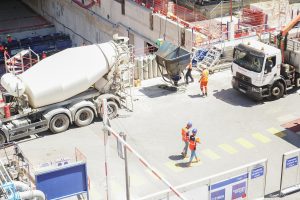
To answer this, it is essential to identify the main sources of nuisance generated by construction sites: the multiplication of logistics flows creating congestion and noise; construction equipment itself, often very loud—hydraulic breakers, vibrating plates, diesel machinery, reversing alarms; and the lack of information for residents, who often have no space for dialogue or dedicated contact point.
Making cities more peaceful therefore requires acting simultaneously on these three levers.
1. Integrating construction logistics into urban planning
Shared construction logistics to limit flows in dense urban areas
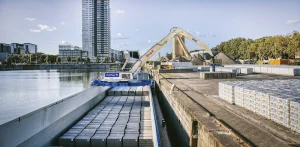
At the scale of a transforming neighbourhood or an area with several simultaneous construction sites, logistics quickly becomes a central issue. Too often, each project organizes its deliveries and flows independently, generating a constant ballet of trucks, traffic congestion and avoidable noise disturbances. One solution is already proving effective in several European cities: the Construction Consolidation Centre (CCC).
This is a shared logistics platform that enables:
-
upstream reception and storage of materials intended for different construction sites within the area;
-
grouped and scheduled just-in-time deliveries;
-
delivery of only the necessary quantities, at the right time and directly to the worksite, based on a pull flow aligned with the actual progress of the works.
The benefits are significant:
-
50% fewer trucks in urban areas,
-
15% fewer losses or material damage,
-
reduced construction site footprint and improved local traffic conditions.
This type of organization—already implemented in Brussels with the Brussels Construction Consolidation Centre (BCCC)—could become a valuable lever for projects in France, particularly in urban development zones (ZAC) or multi-ZAC operations. A concrete example of logistics innovation that can improve urban quality of life.
A first step towards the CCC model: SAVE, setec opency’s digital platform
While CCCs represent a fully developed model of shared logistics, their implementation requires a high level of coordination between multiple construction sites. Before reaching this level of collective maturity, it is essential to gradually structure logistics by equipping projects with tools to better plan, coordinate and manage flows. This is precisely the role of SAVE, the digital platform developed by setec opency and already used on our construction sites. It represents a first tangible step towards shared logistics—a simple, accessible and rapidly deployable solution, suitable for:
-
a single construction site,
-
two or three neighbouring projects,
-
or a transforming urban block.
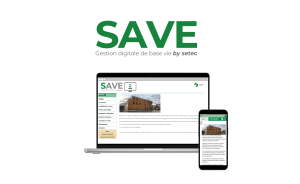
The platform allows users to:
-
reserve delivery time slots (light vehicles, heavy trucks, night deliveries, oversized loads, exceptional transport);
-
manage access badges to strengthen security and control site entries;
-
report non-compliance issues in order to improve coordination and quality.
Mandatory delivery registration via SAVE helps ensure smooth site operations, facilitates coordination between contractors, reduces disturbances for local residents thanks to better flow management, and ensures compliance with local regulations. Designed as a practical, scalable and immediately operational solution, SAVE prepares the ground for the future deployment of CCC-type models. A simple and efficient digital tool serving a more peaceful city.
2. Creating real spaces for dialogue between residents and construction teams
Informing and involving residents throughout the construction process
Construction disturbances are harder to accept when residents have no way to express themselves, no means to understand what is happening, and no visibility on what to expect. This loss of control amplifies stress and conflict. Setting up a structured and accessible space for dialogue therefore becomes a key lever to improve the social acceptability of a project.
Such spaces can take several forms:
-
real-time digital monitoring applications enabling residents to report disturbances, ask questions or follow the progress of works (such as the Parlons Travaux application developed by Toulouse Métropole);
-
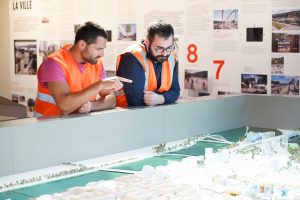
regular or thematic construction site visits to increase transparency and build trust;
-
clear and readable information displayed on site hoardings: simplified schedules, useful contacts, visual indicators such as coloured flags for high-disturbance days, or boards indicating noisy work hours.
Active mediation should no longer be seen as an “optional” component. It is now a key condition for the success and acceptability of urban projects, particularly in highly dense environments.
3. Reducing construction noise through appropriate solutions
Some disturbances are unavoidable, but others can be significantly reduced through proven solutions that are quick to deploy.
Limiting the impact of the noisiest equipment
For hydraulic breakers, vibrating plates, disc cutters and air compressors, inflatable noise barriers are available that provide immediate sound reduction. The solution developed by Flypix, for example, can be deployed in just a few minutes and creates an effective barrier around the noisy work area.
Accelerating the electrification of construction equipment
Electric excavators, mini-excavators and loaders generate far less noise than diesel-powered machines. Although their cost remains higher, including targeted rental clauses in contract documents can be a pragmatic solution, particularly for projects in highly dense urban environments.
Replacing traditional reversing beeps with the “lynx cry”
Less shrill than the traditional beep, this directional signal is more considerate of nearby residents while remaining perfectly safe for operators. A simple, cost-effective solution that is immediately noticeable to local communities.
L’AMO RSE : un levier global pour apaiser les villes en transformation
Beyond technical and organizational solutions, making cities more peaceful during periods of transformation requires a global and structured approach. This is precisely the objective of the CSR Project Management Assistance (AMO RSE) developed by setec opency: supporting project owners and construction teams from the earliest stages to integrate issues related to noise, traffic, air quality and dialogue with residents.
Through dedicated studies, the definition of requirements in tender documents, operational monitoring of construction sites, the implementation of communication systems, and the analysis and reduction of real impacts. By combining methodological tools, practical solutions and active mediation, AMO RSE becomes a key lever to make urban densification more acceptable, more responsible and more harmonious for all city users.
Discover setec opency’s CSR Project Management Assistance
info :
– ADEME : Coût social du bruit en France
– BCCC : Brussels Construction Consolidation Centre
– Toulouse Métropole : App Parlons Travaux
– Flypix : Abris gonflable protection chantier