en


1. A more transparent and fair model for managing shared expenditure

This arrangement enables the joint project expenses to be separated, both legally and for accounting purposes, from the individual accounts of each company. A dedicated structure, with its own accounts accessible to all companies, manages these cash flows, thereby avoiding any confusion with the interests of any particular lot.
The funds paid in by the companies are used solely to finance the project’s shared expenses. They are pooled in a dedicated bank account, which is closely monitored, with regular reports on the accounts and expenditure incurred. Each company thus knows precisely how the money paid in is being used.
The system is based on a simple principle: it is managed on a not-for-profit basis, within the framework of a non-profit organisation under the 1901 Act. No one can appropriate the sums paid in, which guarantees that every euro goes directly towards the building project.
At the end of the project, the accounts are finalised in accordance with the rules set out in the management agreement, with no remaining balance being claimed by any particular party. The money thus remains entirely earmarked for the project, for the benefit of the client and the contractors.
2. An organisation that ensures site safety and enables companies to refocus on their core business
Beyond the financial aspect, outsourcing the pro rata account also improves site organisation.
When a construction company manages this task itself, it finds itself acting both as administrator and contributor to shared expenses. This dual role can create tensions or raise suspicions of favouritism. An independent organisation avoids this problem and strengthens trust between the parties involved. Another key benefit is service continuity. A dedicated manager oversees the operation from start to finish, handles administrative, financial and accounting tasks, and coordinates the shared services necessary for the smooth running of the site.
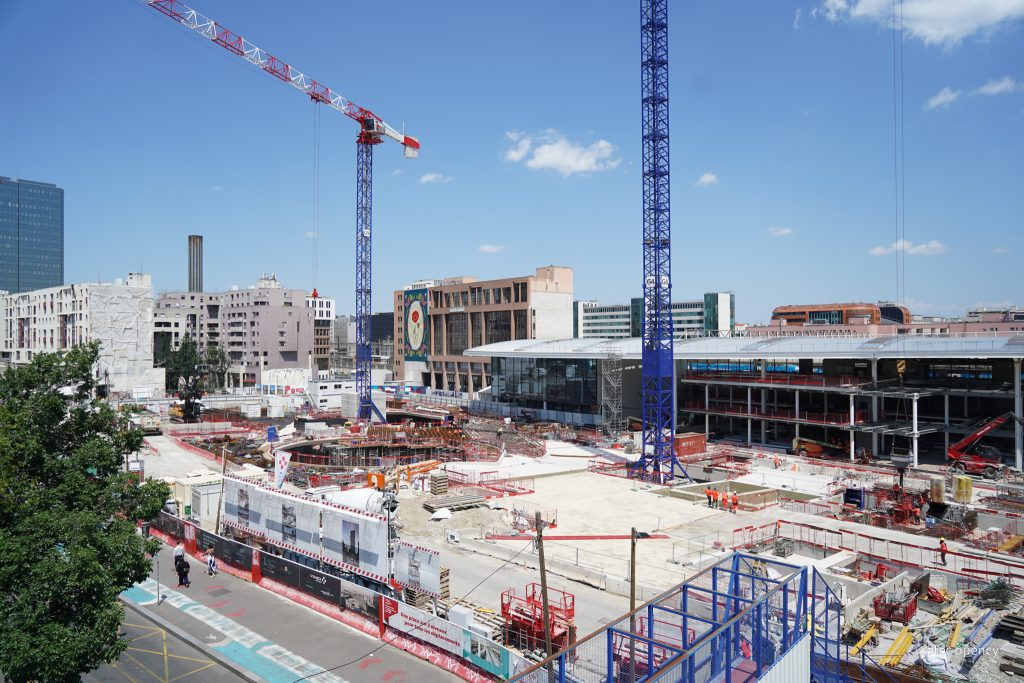
An outsourced pro-rata account also makes it possible to engage an independent logistics manager, responsible, for example, for ensuring that the schedule is adhered to, that the site is kept clean, or that safety standards are met. On the Quadrilatère Phase 2 project, the on-site logistics manager for the pro-rata account was responsible for a team of two to four site cleaners, for monitoring the site’s cordoned-off areas and for closing off these areas as required, … all to enable contractors to work in complete safety.
Construction firms can then focus on their core business: carrying out their contracts whilst meeting cost, quality and deadline targets. Finally, setting up an association ensures the presence of a pro-rata account manager throughout the duration of the project. By entrusting these tasks to a third-party organisation, contractors save time to focus on their own work and better adhere to the schedule.
The governance structure put in place (members’ meeting, audit committee) enables expenditure to be collectively approved and fairly allocated amongst the contractors. Unlike management handled by a construction company, this system avoids any conflict of interest and facilitates the buy-in of all parties involved.
3. Cost optimisation: management that supports the site’s operational efficiency

Unlike a management model run by a construction contractor, this model completely separates procurement relating to shared services from the specific requirements of each contract lot.
The management body can therefore consult directly with service providers responsible for the site’s shared requirements (security, cleaning, site accommodation, waste management, shared resources, utilities, signage, etc.), basing its decisions solely on economic and operational performance criteria. This independence allows for genuine competition and a constant search for the best value for money, without the specific interests of the various works contracts influencing the choices made.
This approach also avoids any commercial considerations regarding shared expenditure. Services are invoiced at their actual cost, without the overheads associated with a management company’s own structure. The cost of the services is increased solely by the management company’s management fees (at a minimum of 8 per cent). The contributing companies fund the services actually required on site at the lowest possible cost.
The practical result is that the pro rata rate is better controlled throughout the project. Expenditure is adjusted to the site’s actual needs, depending on its progress, changing constraints or the contractors’ requests. This flexibility helps to avoid two pitfalls: over-equipping the site from the outset or continuing to fund services that have become unnecessary by the end of the project.
This approach also fosters a genuine culture of collective performance. As each expenditure is charged directly to the pro rata account and monitored collectively, all stakeholders are encouraged to seek more efficient solutions, optimise consumption and limit shared services to what is strictly necessary.
The pro rata account thus becomes a genuine tool for the economic management of the project, rather than merely a mechanism for allocating expenditure. Thanks to independent, transparent and not-for-profit management, resources are allocated as closely as possible to the project’s actual needs, which improves the project’s overall efficiency and protects the interests of both the client and the contractors.
From an economic perspective, this model allows for direct consultation with third-party service providers, independently of works contracts, with a view to optimising shared costs. It excludes, as a matter of principle, any internal costs specific to a construction company. The pro-rata rate is thus better controlled, and the organisation continuously adapts to the actual needs of the site.
On the ILOT LOUBET project in Saint-Étienne, the pro rata account closely tracked staffing levels in order to adapt the site accommodation to the number of staff actually present on site and the various phases of the project. The site accommodation was therefore set up gradually and then dismantled in stages, enabling costs to be optimised whilst precisely meeting the needs of the construction site.
Conclusion
Managing pro rata accounts via a dedicated external structure is not an isolated case: it is now a tried-and-tested solution used by setec opency for numerous complex transactions.
It offers:
- Greater financial transparency;
- Fairer governance;
- Better control over shared costs;
- A clearer separation of responsibilities;
- A more effective organisation working for the benefit of the project.
For both the project owner and the contractors, outsourcing the pro rata account is therefore a governance choice that fosters trust, collective efficiency and effective management of the project.